PENDRECHT
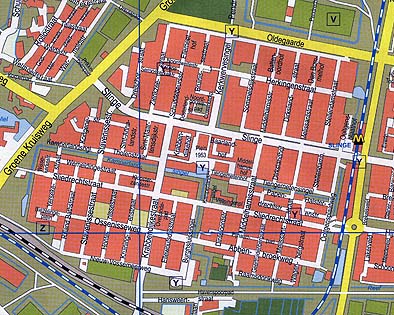
The Pendrecht district, in the south of Rotterdam, was built in the fifties of the last century. It has been designed by the Dutch town-planner Lotte Stam-Beese. The district consists of living units: different blocks of houses are laid out around a communal garden. The rectangular pattern is remarkable as well; all streets cross each other at right angels. Click here to view the map of Pendrecht in full size.
The building of Pendrecht started shortly after the floods in 1953 which affected the south-western part of the Netherlands. Therefore all streets are named after villages which were flooded at that time. The central square is named Plein 1953 ("Square 1953").
Pendrecht was built as a garden city with wide streets and much greenery. House-hunters were very happy if they succeeded in getting a home in Pendrecht. In the beginning many people, even from abroad, came to Pendrecht to see this masterpiece of town-planning.
But times have changed. As many of this kind of districts, Pendrecht came in a downward spiral as well. Especially the last years the pauperizing took a big shape which could be read in the newspapers regularly.
In the nineties the improvement of the dated blocks of houses has begun. This will also include demolishment which will change the face of the district. However, everything will be done to keep the unique pattern as much as possible.
It sounds conflicting but all those negative publicity eventually had a positive result: a lot of activities are now carried out to stem the tide. And it pays off: recent polls show clearly that the situation in Pendrecht is improving slowly. There is still a long way to go but the negative image is broken down at last!
I have lived in Pendrecht for most of my life which gives me a special relationship with the district. I have been through many events and developments so I know a lot of Pendrecht's history. My interest in architecture and town-planning does the rest, insiders pretend I know every spot in Pendrecht. I regularly walk with interested people through Pendrecht to show the district.
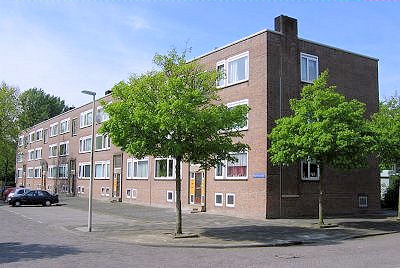
I grew up in the Wagenbergstraat, in the south-eastern part of Pendrecht. The photograph shows the block where I lived, our home was on the top floor. Due to the restructuring of Pendrecht, the renovation of this block started in 2019.
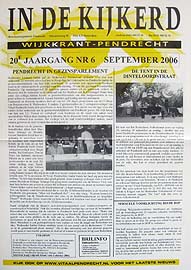
Due to my involvement in Pendrecht I am volunteer on the District Society (Bewonersorganisatie Pendrecht, BOP) where I am editor of the district newspaper. The main purpose of the newspaper is to inform the district inhabitants what is going on in Pendrecht, that's why it is named In de Kijkerd ("in the picture") which is symbolized by the yellow eye on the front page.
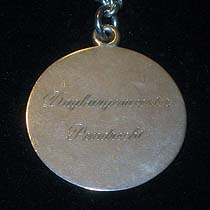
In December 2003 the Mayor of Rotterdam, Ivo Opstelten, appointed me as Day Mayor of Pendrecht. At the same occasion Roger Huys became the Night Mayor of Pendrecht. The both Mayors of Pendrecht can be seen and heard (in Dutch) on the internet. Go to the website of Vitaal Pendrecht (= "Vital Pendrecht"), click on Webvideo and choose from the list at the right Twee Burgemeesters van Pendrecht in gesprek (= "Two Mayors of Pendrecht are talking").
Though my function as Day Mayor is symbolic, it has nice sides. To give an example: I got a request to take part in a selection committee to choose a suitable name for a new block with elderly homes. I did so and I was pleased to be asked for that.
At the moment an artist is making a painting from me as Day Mayor of Pendrecht. In October 2007 I had to pose for the first time and there will be another session during my Christmas holidays. The painting is being made by Mila Jeleznikova and I am looking forward to the final result.
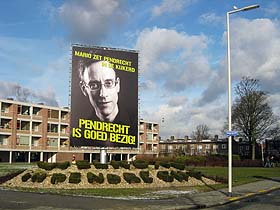
Pendrecht is still improving but many people outside the district don't notice that. Therefore the municipality started a campaign named Pendrecht is goed bezig ("Pendrecht is doing well"). Every month an inhabitant is the hero, his/her photograph is on a billboard (7 meters high) close to the underground station Slinge.
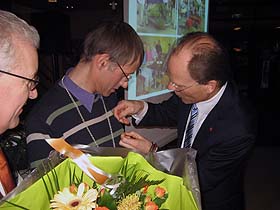
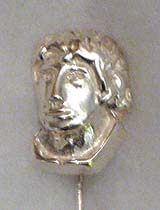
In Januari 2010 it was my turn to be the hero. At the end of the month I gave a photo presentation in the community centre in which I looked back to 2009. During my speech an alder-man entered the room and much to my surprise I received a municipal decoration for my volunteer work in Pendrecht. I felt very honoured!
As I realise that it is hard to get an impression of Pendrecht when you have never been there, I have created a photo gallery. Click on the button at the bottom of this page to view the photographs.
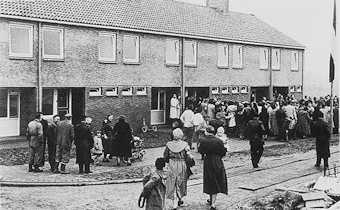
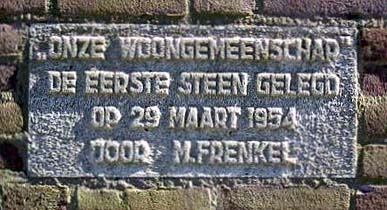
The housing association OWG (short for Onze Woongemeenschap, "Our Living Community") was founded in 1950. Three years later they started building the first houses in Pendrecht. The first stone, a tablet with inscription (move over the photograph to read the translation), was laid on 29 March 1954 by Meijer Frenkel, the then Secretary and Treasurer of OWG. The first block consisted of 6 family houses and was delivered on 2 November 1954. On that historical day, the Alderman of Public Housing handed over the keys to 6 happy families. The building works continued and nearly 10 years later, Pendrecht was finished.
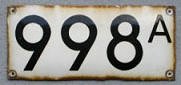
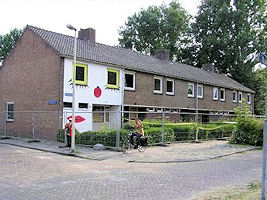
Fifty years later, the oldest houses in Pendrecht were in bad condition and renovation turned out to be too expensive. The right photograph shows the same houses, shortly before demolition in 2004. I was just in time to save one of the original house number signs. Happily the first stone has been removed in time and was temporaly stored at de Nieuwe Unie ("the New Union", the successor of OWG). The first pile for the new houses was driven on 16 May 2007 and hopefully the historical stone will be re-placed!


The public transport in Rotterdam is carried out by the RET ("Rotterdam Electric Tramway"). Originally two bus routes served Pendrecht but in 1968, the year of the opening of the first underground line in Rotterdam, the bus network was changed dramatically. Pendrecht got a new route, with the number 66, which became very popular. During many years a Route 66 sign (referring to the well-known highway in the USA) was displayed in the shelter at the Pendrecht terminus.
In 1970 the underground line was extended to Pendrecht. From Slinge station it was now just less than a quarter to the city centre. However, this did not affect the bus network so route 66 remained.
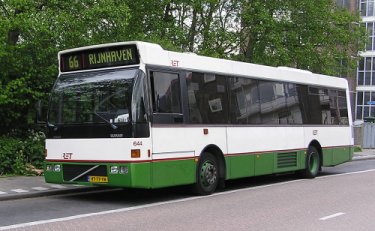
At the end of 2003 the RET was compelled to reduce costs so they made a plan to rearrange the network. This turned out to be a disaster for Pendrecht as two bus routes, including route 66, would disappear out of the district. Route 66 will be replaced by a route 47 which a much worse service.
The inhabitants were very annoyed at these changes so they started a campaign. But it had no result: the measures will be carried through. The photograph shows a bus at the Pendrecht terminus, shortly before route 66 was withdrawn from Pendrecht after 36 years of service.
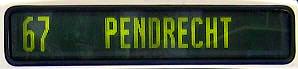
The new schedule became effective in May 2004 and, as expected, there were many complaints. Some months later the RET too recognized that some of the changes turned out wrong. On 10 January 2005 the network changed again. Route 47 disappeared out of Pendrecht and is replaced by a new route 67.